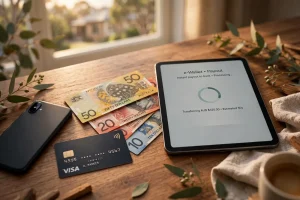
PayID uses a bank account approved in a banking app; mobile access alone does not mean a casino can charge a phone bill.

“Pay by phone” can describe two different things. One is using a phone to make a payment through a banking app. The other is having a purchase added to a mobile account and collected through a telephone bill or prepaid balance. The screen may be the same; the payment route is not.
PayID belongs to the first category. On a mobile, the player starts a deposit on the casino payment page, selects PayID and enters an amount. The payment is then confirmed in the player’s banking app. The money is sent using the bank account, rather than being added to a telco bill. A phone is simply the device used to initiate and approve the transfer.
That distinction matters because “mobile casino” describes where a site is accessed, not how a deposit is funded. A page that works on a phone does not thereby accept phone credit. Nor does the presence of a mobile-friendly cashier establish that charges can be placed on a phone bill. Those are separate claims about separate payment arrangements.
I have seen payment labels treated as if they were interchangeable because they all appear beside a deposit button. They are not. A banking-app transfer requires the bank’s approval and uses a bank account. Phone-bill billing would involve the telecommunications account or prepaid balance. A card payment entered on a handset is another route again. The device alone tells nothing about which one is being used.
With PayID, the basic mobile flow is straightforward: select the method in the cashier, enter the deposit amount, and complete the payment in the banking app. Before confirming, the recipient details should match the intended payment destination. The required player ID or username should also be included in the payment reference if the casino’s instructions call for it; leaving it out can prevent automatic matching and leave a deposit awaiting review. The reference field is not decorative. It is part of how the payment is associated with an account.
The mobile interface can make that detail easy to overlook. A banking app may present the recipient and reference on different screens, and the casino’s cashier may show instructions separately from the bank’s confirmation page. I would treat the transfer as incomplete until the details have been checked together: amount, recipient and reference. A payment should not be confirmed just because the amount looks right.
The word “instant” can also blur the distinction between the payment and the gambling service. A transfer method may be available through a bank app, but that does not make every service displaying it lawful or suitable for use in Australia. Under the Interactive Gambling Act 2001, providing real-money online casino games—including pokies and table games—to people located in Australia is prohibited. The fact that a website opens on a mobile phone, or that a banking app can send a payment, does not alter that legal position.
That is why searches for casino games charged to a mobile bill should not be read as proof that a phone-bill product exists or is available in Australia. A promotional phrase can describe a billing mechanism, a mobile-optimised website, or simply a payment initiated by phone. Those meanings are not equivalent. The relevant question is what account is actually debited, and whether the underlying service may lawfully be offered to people in Australia.
For PayID, the answer to the first question is clear: the payment is approved through the player’s bank, not collected as a telephone charge. That is a description of the payment mechanics, not an endorsement of using it for online casino play. A payment option does not validate the operator or change the rules applying to the service. The distinction is plain. The legal position remains.
A PayID deposit has two distinct outcomes to track: the money can reach the casino’s payment details, and the casino can then match that payment to a player account. Those steps are related, but they are not the same. A transfer that has left a banking app is not necessarily visible as spendable funds in an account straight away.
PayID deposits are started in the player’s banking app. Once sent, they typically reach the casino within seconds—commonly in the range of 3 to 15 seconds. That is the payment’s arrival window, not a promise that the account balance will update at precisely the same moment. The casino also needs enough information to identify which player made the transfer.
The payment reference is the join between those two sides. A casino may require a player ID or username in that field so its system can associate the incoming funds with the correct account. When the required identifier is present and recognised, the deposit can be credited automatically. When it is absent, the money may arrive but remain pending because the automated matching step has no reliable account to attach it to.
That distinction explains a common point of confusion: a fast bank transfer can still be followed by a delay in account credit. The transfer’s arrival and the casino’s recognition of its owner are separate events. The reference is not decorative payment text; it is part of the matching information.
The first useful distinction is whether the payment has been sent and whether it has been credited. Repeating a deposit before checking can create a second transaction without resolving the first one. The relevant detail is the reference used on the original payment: if the casino required a player ID or username and it was left out, or entered incorrectly, automatic crediting may not happen.
A payment in that position may need manual support processing. That means the arrival of funds does not by itself settle the account-matching issue. Support has to establish which player account the transfer belongs to before it can be dealt with. No fixed processing time follows from the PayID arrival window, so the seconds quoted for the transfer should not be treated as a deadline for a pending deposit to appear.
There is a practical difference between a missing identifier and a slow transfer. In the first case, the payment may have reached the recipient while the casino cannot automatically assign it. In the second, the account may still be waiting for the payment to arrive. The same unchanged balance can therefore have different causes; the reference is one of the first details relevant to resolving the mismatch.
From the counter side, this is where a small field can carry more weight than its appearance suggests. Payment systems move funds; account systems allocate them. When the allocation key is missing, speed on the payment side does not repair the account record. A quick transfer. A separate matching job.
The typical 3-to-15-second window describes how quickly a PayID deposit reaches a casino. It does not establish that every operator uses the same crediting process, or that every payment will appear in the player balance on that exact schedule. The reliable conclusion is narrower: PayID can deliver the transfer within seconds, while an absent required reference can leave the deposit pending and call for manual handling.
That is why “instant” can be an incomplete description. It may accurately describe the transfer while saying nothing about whether the casino has identified the player. In payment language, delivery and reconciliation are different stages. The distinction matters most when the account balance has not changed even though the banking app shows a completed payment.
There is also a legal boundary to keep clear in Australia. The Interactive Gambling Act 2001 prohibits operators from providing real-money online casino games, including pokies and table games, to people located in the country. A description of how PayID crediting works is not a recommendation to use an online casino or a claim that a particular service is lawful or available to Australians.
For any deposit already sent, the core issue is whether the required player identifier was included and whether the casino can match it. The transfer may arrive quickly; account credit depends on successful matching.
Choosing a pay-by-phone casino in Australia means checking which payment details and operator credentials are actually available before deciding where to play. Use these brief profiles as a starting point, and confirm current payment options directly with each casino.
Neospin
Neospin is listed with a Curacao Gaming Control Board licence, number OGL/2023/176/0095, held by Hollycorn N.V.
Ricky Casino
Ricky Casino lists crypto payouts in under an hour and PayID payouts in 1–3 business days. Its minimum deposit is A$20, or A$30 to qualify for the bonus.
Roby Casino
Roby Casino is listed with a Curacao eGaming licence held by Roby Games Ltd.
Uptown Pokies
Uptown Pokies is listed as Curacao-licensed and operating since 2017. Its minimum deposit is A$20.
7Bit Casino
7Bit Casino is listed as Curacao-licensed and operated by Dama N.V.
SpinsUp
SpinsUp is listed with a Curacao Gaming Control Board licence, number OGL/2023/174/0082, held by Dama N.V.
Lucky Dreams
Lucky Dreams lists a Curacao licence and a A$20 minimum deposit for POLi.
LuckyVibe
LuckyVibe is listed with a Curacao Gaming Control Board licence, number OGL/2023/176/0095, held by Hollycorn N.V.
Golden Pokies
Golden Pokies is listed as Curacao-licensed.
Bizzo Casino
Bizzo Casino is listed with a Curacao Gaming Control Board licence held by TechSolutions Group N.V.
“Pay by phone” can describe two different things. In one, a purchase is charged to a mobile account or phone bill. In the other, a payment is made using a phone, typically through a banking app. The device is the same; the payment arrangement is not.
That distinction matters when the phrase appears beside casino language. A mobile number in a payment process does not, by itself, mean the cost is added to a phone bill. Nor does a page describing a payment as “phone-based” establish that a carrier-billing service is available. The wording can conceal a simple category error.
For people looking up pay by phone casinos in Australia, the practical point is that the phrase alone does not identify a verified payment product. It may refer to billing through a telecommunications provider, or merely to a bank payment initiated on a mobile. Those routes have different providers and account relationships. A bank transfer remains a bank transfer even when the banking app is open on a phone.
It operates through the New Payments Platform (NPP), the banking infrastructure that supports real-time payments. Instead of relying only on conventional account details, a user can send or receive money through an identifier linked to an account, such as a mobile number or email address.
The mobile number is an identifier, not the source of the funds. The money moves through the banking system from a bank account; it is not automatically billed by a mobile carrier. That is the point most likely to get lost in a casual “pay by phone” label.
I have seen payment descriptions do too much work. “Instant” may describe the payment rail, while saying nothing about how an account is handled on the other end. “Mobile” may describe the screen used to make a payment, not a distinct payment method. Labels are not mechanics.
There is also a legal boundary that cannot be separated from the Australian context. Under the Interactive Gambling Act 2001, operators cannot provide real-money online casino games, including slots and table games, to people physically in Australia. The phrase “pay by phone casino Australia” does not change that position or establish that a service is lawful or available. Describing a payment method is not an endorsement of a casino service.
So the distinction is narrow but important: phone-bill billing means a charge is routed through a telecommunications account; PayID means a bank-account payment sent through the NPP using a linked identifier. A payment made on a phone is not necessarily a payment charged to a phone bill. That difference is the whole story.
A promotion’s headline is not its value. The operative terms decide how much of it can be used, what activity is required before winnings become withdrawable, and whether a cash-out is capped. I have seen the headline do the selling and the conditions do the accounting. The distinction matters.
A wagering requirement sets how much qualifying play must take place before bonus funds or related winnings can be withdrawn. It is not the same as a cash bonus that can be taken straight out. The wording also matters: terms may define which balance is subject to the requirement and when the calculation begins. Without those details, the headline alone cannot show the amount of play involved.
A maximum-bet condition limits the stake permitted while a promotion is active. Exceeding it may affect eligibility for bonus funds or winnings, depending on the terms. This is one of the clauses that can turn an apparently generous offer into a narrow one: the player may be allowed to keep playing, but a breach can change what remains payable. Small print. Real consequence.
Game weighting sets how different games count towards wagering. A game that contributes less can require more play to meet the same stated requirement than one that counts in full. This is why a bonus attached to online pokies cannot be judged by its headline or by the presence of a particular game category alone. The terms must say which games count and at what rate; a payment method does not establish either point.
Time limits add another constraint. A promotion may have a period in which it must be accepted, used or cleared, and those are not necessarily the same stage. If the clock runs out before the conditions are met, the remaining bonus or related winnings may be forfeited under the rules. The exact trigger and consequence need to be read rather than inferred from a banner.
A maximum cash-out cap limits the amount that can be withdrawn from a promotion, even where the wagering conditions have been met. That can make a large advertised bonus less valuable than it first appears. The cap may apply to bonus-derived winnings, so its scope matters as much as the figure itself. The terms should make clear what balance is affected and whether the cap is tied to the bonus.
Searches for a pay-by-phone casino deposit bonus can blur two separate questions: how a deposit is made and what a promotion requires. Paying from a phone does not establish that a phone-bill charge is accepted, that a bonus is available, or that any particular game qualifies. Nor does a label such as “best” explain the wagering rule, bet ceiling, game weighting, expiry conditions or cash-out cap. Those are separate claims, each needing its own evidence.
There is also a legal boundary in Australia: the Interactive Gambling Act 2001 prohibits operators from providing real-money online casino games, including pokies and table games, to people located in the country. Bonus language does not change that position. A promotion’s mechanics can be described; it should not be treated as an endorsement or an invitation to use an offshore casino.
“No wagering” sounds like a clean promise: bonus winnings can be withdrawn without first placing qualifying bets. In practice, the wording needs to be read alongside the offer’s rules. I look for whether the label applies to the bonus itself, any winnings generated from it, or only a particular part of the promotion. Those are not interchangeable arrangements.
A no-deposit offer has a different point of friction. It may not require an initial payment, but that does not tell us whether it has eligibility limits, an expiry condition, a maximum cash-out, or restrictions on the games that count. The key distinction is between receiving a promotional balance and being able to withdraw its proceeds. The headline describes the first step; the terms determine what follows.
The same checks still matter when an offer is described as having no wagering. Look for a maximum bet condition, game weighting, a time limit and any cap on cash-outs. A promotion can remove a wagering requirement and still restrict how winnings are earned or paid. If the rules do not explain what happens to winnings after play, the phrase alone is not enough to establish that they are freely withdrawable.
Payment wording needs separate scrutiny. A no-deposit promotion does not, by itself, prove that a casino accepts phone-bill charges, a payment made using a mobile number, or any particular phone-payment service. Nor does the phrase “pay by phone” establish that the promotional balance can be claimed through that route. I would treat payment eligibility and bonus eligibility as two separate questions, with separate terms.
Country labels do not settle the issue either. A reference to the Netherlands does not establish that an offer is available to people in Australia, and a phone-payment label does not establish which countries or payment rails are supported. In Australia, the Interactive Gambling Act 2001 prohibits operators from supplying real-money online casino games, including pokies, to people located in the country. Advertising those services to Australian audiences is also prohibited. A promotional headline cannot change that position.
The practical test is documentary: whether the terms clearly define eligibility, any required play, maximum bets, game weighting, time limits and cash-out restrictions. If those details are absent or contradict the headline, the headline is not a reliable description of the offer. No clean answer.
A claim that a casino takes payment by phone bill answers only a question about how a deposit might be charged. It does not establish whether the service is connected to BetStop, whether a person is excluded, or whether play is permitted in Australia. Those are separate matters, and one label cannot prove the others.
The same distinction applies to searches for a phone-bill casino said to be “not on BetStop”. That wording can sound like a feature or a route around an exclusion, but it is not evidence of either. BetStop status is not a payment setting. A deposit method, even if accurately described, cannot confirm a person’s exclusion status or override it.
There is another issue that tends to disappear in payment advertising. Under Australia’s Interactive Gambling Act 2001, operators cannot provide real-money online casino games, including slots, poker and table games, to people physically in Australia. The payment rail does not change that rule. A phone-bill charge, a bank-app transfer or a claimed absence from an exclusion register does not make the service lawful to provide.
I have seen how a simple payment phrase can carry more weight than it deserves. “Pay by phone” may mean a charge added to a mobile account, or it may refer only to using a phone to access another payment method. A mention of Boku is likewise a claim about a particular billing route, not proof of BetStop status, legal availability or a real-money product. The wording is not the whole service.
Searches also combine phone-bill deposits with no-deposit offers, real-money play, bingo or slots. Those combinations do not establish that a product exists or that the stated terms apply. A result can repeat a payment claim without showing what is charged, who receives it, or what restrictions govern access. “No deposit” does not resolve any of those questions.
The practical reading is narrow: payment-method claims concern payment; BetStop claims concern exclusion status. Neither should be treated as proof of the other, and neither changes the Australian legal position on online casino games. A confident label is still only a label.
A payment option says how money can be sent; it says nothing reliable about the games behind an account. A site displaying PayID does not thereby prove that it offers pokies, that a particular title is available, or that a promotion applies to those games. Payment pages and game catalogues answer different questions.
That distinction matters in searches for casino games or slots linked to phone payments. The phrase may mean a deposit initiated on a mobile, but it can also be read as a phone-bill charge. Neither interpretation confirms a game selection. I have seen payment labels used as shorthand for an entire product, when they describe only one part of the transaction. A label is not a catalogue.
The same applies to a bonus associated with a payment method. A promotion’s headline does not establish that pokies qualify, or that all eligible games contribute equally towards its conditions. Game weighting determines how much activity on a particular game counts toward a bonus requirement. The practical effect can be that one game advances the requirement more slowly than another, or does not count at all. The wording in the terms—not the payment badge—sets that boundary.
“Slots bonus” can sound broad. The fine print may narrow it by game category, eligible titles, contribution rates, or exclusions. Those conditions affect whether the promotion can be used as expected; they do not prove that the named games are available to people in Australia. A game list and bonus rules are separate claims, and each needs to stand on its own.
There is also a legal boundary that payment language cannot change. Under the Interactive Gambling Act 2001, operators must not provide real-money online casino games, including pokies and other casino-style games, to people located in Australia. Advertising those services to Australian audiences is also prohibited. A phone payment label does not make such an offer lawful or establish local availability.
Searches mentioning Germany do not alter that position for someone physically in Australia. A reference to another country, a payment method, or a bonus cannot establish that an offshore casino game service is available or permitted here. The categories get blurred. The underlying claims do not.
A deposit described as a payment for online slots still has two separate parts: the movement of money between bank accounts and whatever an operator does after receiving it. The distinction matters. A real-time payment rail can settle a transfer quickly; it does not decide whether a gambling service may be offered in Australia, nor does it make an operator’s account balance update automatically.
PayID operates through Australia’s New Payments Platform (NPP). The sender uses an identifier linked to the recipient’s account, and the transaction settles through the banking network in real time. That describes the payment layer, not the destination’s business practices. “Instant” is a statement about settlement, not a promise about what happens at the other end.
In operational terms, the rail carries a payment instruction from one financial institution to another. It does not assess a casino account, confirm a player’s identity, or determine whether a deposit should be credited to a particular profile. Those are separate decisions outside the settlement function. The money can move in real time while an operator’s systems or staff handle account records on their own timetable. Different stages; different controls.
That is why descriptions such as “pay by mobile” can blur the mechanism. A transaction initiated through a phone may still be a bank payment over the NPP, rather than a charge placed on a mobile bill. The device is not the rail. Nor does the word “slots” identify a payment product: pokies are a type of game, while PayID is a way to transfer funds.
There is also a legal boundary that payment terminology cannot remove. Under Australia’s Interactive Gambling Act 2001, providing real-money online casino games, including slots, to people physically in Australia is illegal for operators. A payment network’s ability to settle a transfer does not make the gambling service lawful or endorse its use.
From the payments side, the useful conclusion is narrow: PayID uses the NPP, and its transfers settle in real time. That says how funds travel, not whether a gambling site is permitted to serve Australians or how it handles an account. Different questions. Different systems.
“Credit casino” can describe two different things: a card transaction funded from credit, or a deposit made with a card brand that also issues credit cards. The distinction matters. Visa and Mastercard are widely accepted for deposits according to specialist payment reviews, but that does not establish that a particular transaction uses credit rather than debit. Nor does it make credit-card funding an available option for online gambling services in Australia.
A card brand is not a withdrawal promise. Specialist reviews also report that card withdrawals may take longer than deposits or may not be available, depending on the payment processor. The operator may instead offer another payout route. That is a processing constraint, not evidence that money can be returned to the same card in every case.
There is a second condition behind the apparent choice. Specialist reviews describe operators requiring a withdrawal to go back through the deposit method where that route supports payouts. “Same method” sounds simple; in practice, the method may not handle both directions. A deposit card that cannot receive a payout leaves the withdrawal process dependent on the alternatives the operator makes available.
Bank transfer is one such alternative, but it is not interchangeable with a card transaction. A bank transfer withdrawal requires bank details, and identity documents may be requested before funds are released. A bank wire deposit can also involve fees and may take longer to appear than an electronic card payment. The route needs to be assessed in both directions, not just by how easily a deposit can be initiated.
Phone-bill products and services promoted under names such as Boku are a separate category from card payments. A phone number appearing in a payment description does not mean the charge is billed to a mobile account. Payment branding alone cannot confirm a method’s availability, its withdrawal support or whether a transaction is permitted.
The legal boundary is decisive in Australia: providing real-money online casino games to people physically in the country is illegal for operators. Payment terminology does not change that. No card route makes the underlying service lawful.
“Free” describes the spins, not necessarily the cash-out. The practical value depends on the conditions attached to any winnings and whether those conditions can be met. I look past the headline to the wagering requirement, maximum bet, eligible-game weighting, time limit and any cap on withdrawals. Each can narrow what a promotion is worth.
A phone payment does not, by itself, establish that free spins are available or that phone credit can be used to claim them. The payment route and the bonus rules are separate questions. A claimed offer needs clear terms explaining how spins are assigned, what happens to winnings and what must be completed before withdrawal. Without those details, “free” is just a label.
The key distinction is between receiving spins and being able to withdraw their proceeds. A cash-out cap can limit winnings even after other conditions are met; a time limit can leave too little room to complete them. Game weighting matters too: play on some games may count differently towards a requirement. Small print. Big difference.
There is also a legal boundary in Australia. Under the Interactive Gambling Act 2001, operators cannot provide real-money online casino games, including slots, to people physically in the country. That applies to promotional mechanics attached to those games as well; a free-spin label does not change the nature of the service.
I would treat claims about spins funded by phone credit with the same care as any other bonus claim: the terms must explain the cost in restrictions, not merely present the spins as a gift. No clear conditions, no clear value.
PayID casino deposits commonly start at AUD 10–20, though some accept as little as AUD 5. The maximum depends on your bank’s PayID limits; most major Australian banks allow AUD 1,000–5,000 per transaction and AUD 10,000–20,000 per day.
PayID casino deposits commonly start at AUD 10–20, with some casinos accepting deposits as low as AUD 5.
Most major Australian banks allow PayID transactions.
PayID deposits typically reach the casino within 3–15 seconds. Account crediting may take longer if the casino cannot match the payment reference to your player account.
Yes, PayID can be used for casino withdrawals where the operator offers it. The casino may need to approve the withdrawal first, and it may require you to use the same method as your deposit where possible.
At top-rated PayID casinos, verified withdrawal requests are typically reviewed and approved within 2–6 hours. After approval, PayID payouts may arrive within minutes to hours.