A practical look at browser and PWA access, offshore-site risks, payment terms and the conditions behind mobile casino offers.
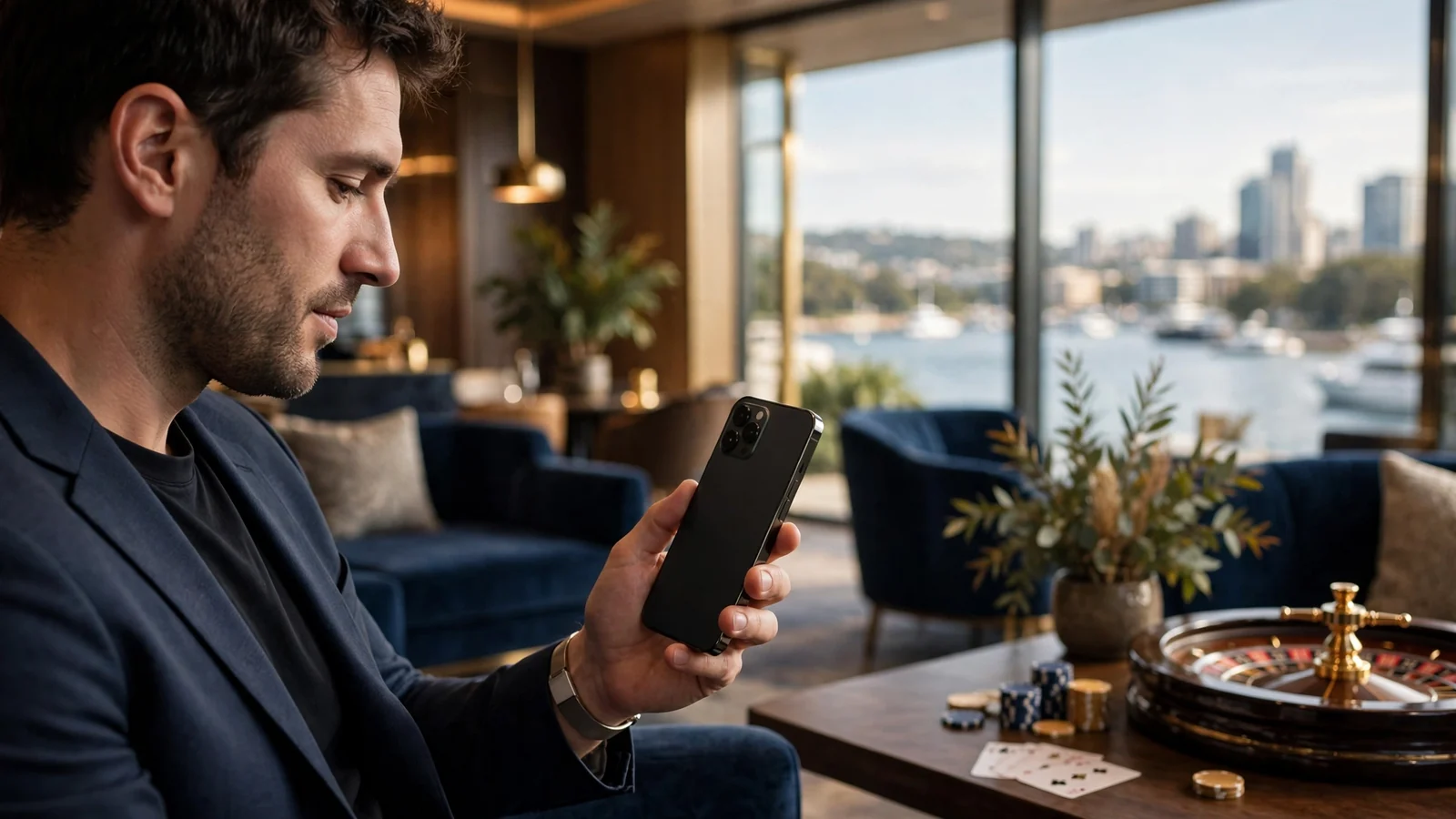
On a phone, access to an offshore casino site generally starts in a web browser. That is not just a design preference. Casino apps are rarely available through Google Play or the Apple App Store in Australia, so a browser page is the usual route. Operators that accept Australian users tend to rely on a mobile version of their website or offer a Progressive Web App, rather than a native app distributed through an official store.
The practical distinction is where the service runs. A browser opens the casino’s website and displays its mobile layout. A native app is installed as a separate application built for the phone’s operating system. A PWA sits between those formats: it remains a website, but can be added to the home screen and opened in a way that resembles an app.
I have found it useful to think of a PWA as a saved doorway, not a separate casino product. Its pages and account functions are supplied by the website. Adding the shortcut does not create a new account or turn the service into a native application. It changes how the site is reached and presented on the device.
Choosing a mobile casino in Australia involves more than finding a familiar name: licensing, payment details and other published terms can help you decide what to check before signing up. Use this list as a starting point and verify the current conditions that matter to you.
Neospin
Neospin is listed with a Curacao Gaming Control Board licence, OGL/2023/176/0095, held by Hollycorn N.V. This provides a specific licensing detail to check when assessing the casino.
Ricky Casino
Ricky Casino lists crypto payouts in under an hour and PayID payouts in 1–3 business days. Its minimum deposit is A$20, or A$30 to qualify for the bonus.
Roby Casino
Roby Casino is listed as operating under a Curacao eGaming licence held by Roby Games Ltd. That licensing information is the available point of reference for this entry.
Uptown Pokies
Uptown Pokies is listed as Curacao-licensed and operating since 2017. Its minimum deposit is A$20.
7Bit Casino
7Bit Casino is listed as Curacao-licensed and operated by Dama N.V. These details offer a concise starting point for checking its regulatory and operating information.
SpinsUp
SpinsUp is listed with a Curacao Gaming Control Board licence, OGL/2023/174/0082, held by Dama N.V. The licence and operator are the available specifics for this entry.
Lucky Dreams
Lucky Dreams lists a A$20 minimum deposit via POLi. It is also listed as Curacao-licensed.
LuckyVibe
LuckyVibe is listed with a Curacao Gaming Control Board licence, OGL/2023/176/0095, held by Hollycorn N.V. The stated licence details provide a concrete point to consider.
Golden Pokies
Golden Pokies is listed as Curacao-licensed. No further operator-specific details are available here, so check its current terms directly.
Bizzo Casino
Bizzo Casino is listed as licensed by the Curacao Gaming Control Board, with TechSolutions Group N.V. as operator. These are the available specifics for assessing this entry.
Most Australian mobile casino access is through a phone browser. The same account can be used on desktop and mobile, so moving between devices does not generally mean setting up a second profile. The site recognises the account; the screen and controls adapt to the device in use.
That shared access is the main convenience of browser play. A punter can sign in on a desktop and later open the same site on a phone, without treating the mobile version as a separate service. Account details and activity belong to the account, not to a particular screen. The interface may rearrange menus, buttons and page sections to fit a narrower display, but that is a presentation change rather than a different account.
There is a trade-off. A browser page depends on the browser and the connection being used at that moment. The site must load, and the phone needs to display it properly. A shortcut can make returning to the page feel more app-like, but it does not remove that underlying dependency. The web service is still doing the work.
This distinction can be obscured by the word “app”. In a promotional description, it may refer to a native application, a PWA, or simply a mobile-friendly website. Those are not interchangeable formats. The installation method is a useful clue: a casino site that offers an add-to-home-screen prompt is providing a PWA-style shortcut, not necessarily an app from an official store.
A PWA is a shortcut to a casino website that behaves more like a native app on a mobile device. It can be installed from the website itself: tap the install or add-to-home-screen prompt, then confirm. Once added, its icon appears alongside other items on the home screen and can be used to open the site.
The key word is “behaves”. A PWA can provide an app-like entry point, but it remains connected to the website behind it. It is not evidence that the operator has published a native app, nor does the shortcut by itself establish anything about the site’s reliability or safety. Those are separate questions.
A native app is installed as software for the device. A PWA is a website presented through an installed shortcut. For many people the difference is mostly about access: whether the site is opened from a browser tab or from an icon. For the operator, it also avoids relying on an app-store listing, which is relevant in a market where casino apps are rarely listed in the major stores.
Some sites may suggest downloading an app file directly rather than using the browser or a website-based PWA prompt. That is sideloading. Sideloaded casino apps carry security risks, and their safety depends on the operator. An app file outside the official stores does not receive the same store-based distribution checks; the label “mobile app” is not a security guarantee. The browser remains the more straightforward format to identify: the address bar shows that the service is being opened as a website.
The services discussed in this context are offshore and crypto-friendly. Their availability can vary, and a site’s willingness to accept an Australian location must be confirmed before any deposit. Using a VPN to reach a blocked casino may breach its terms, void winnings or lead to account closure. If an offshore casino refuses to pay, there is no Australian government body that can resolve the complaint.
That matters even when the technical setup is simple. A working mobile page, a home-screen icon and a shared account explain how access functions; they do not establish that a service is appropriate or available to a particular person. Browser access is the default format, not a recommendation.
Australia’s legal distinction is between the operator and the person using a service. Under the Interactive Gambling Act 2001, an operator cannot lawfully provide online casino-style games to people located in Australia. That covers services built around casino play, rather than making the act of an individual playing at an offshore casino an offence under that Act. The restriction is on supply. It does not turn an offshore operator into a locally authorised one.
The Australian Communications and Media Authority (ACMA) works to restrict access to illegal gambling services, including by blocking websites. A page loading on a phone is not evidence that its operator can lawfully offer casino games in Australia, nor that access will remain available. Blocks can interrupt access; they do not create a local consumer-protection route.
The services discussed here are offshore and crypto-friendly. A licence shown by an operator may come from a jurisdiction such as Curaçao, Malta or Gibraltar. That identifies an overseas licensing framework; it is not an Australian casino licence and does not override the Australian prohibition on operators supplying online casino games to people here. In my experience, the distinction is easy to miss when a site presents its licence badge as a broad assurance. It is not one.
Location acceptance is a separate practical question. Before depositing, the site’s terms and account rules need to be checked to confirm whether it accepts users physically located in Australia. A site appearing in a browser or accepting a registration does not settle that point. Nor does a payment option. If the terms exclude the location, proceeding can put the account and any balance at risk.
A VPN does not solve the problem. Using one to reach a blocked casino or disguise location may breach the operator’s terms; the consequences can include voided winnings or account closure. I have seen location controls treated as account conditions, not as a technical inconvenience to work around. Access is not permission.
There is also a sharp difference between an overseas complaint process and Australian recourse. If an offshore casino refuses to pay winnings, there is no Australian government body that can take the complaint and compel that operator to pay. A foreign regulator or dispute process may be named in the terms, but that is not equivalent to an Australian authority with power over the service. This is the risk that tends to disappear beneath polished account pages.
Registration and gambling are restricted to adults: a person must be at least 18. That age rule does not change the operator restriction or make an offshore service locally regulated. The legal position is therefore not a simple endorsement or warning aimed at the individual punter. The operator is prohibited from supplying the service in Australia; the player’s position under the Act is different, while practical risks—blocked access, account closure and no Australian government avenue for a payout dispute—remain.
A polished mobile page is not proof that it will work reliably on a particular phone. The useful test is practical: whether pages load consistently, controls respond, and the display remains usable during ordinary navigation. A site can look finished in a screenshot and still behave poorly on a real device.
I treat reliability as a pattern, not a single successful visit. A delayed screen may come from the connection, the phone or the site; one glitch cannot identify the cause. A specialist review lists poor connection, limited device memory, an outdated browser and too many background apps among common causes of mobile casino problems. Those factors matter because the same symptom—an unresponsive screen—can have different explanations.
Start with the basics before judging the site. Check whether the browser is current, close background apps that are not needed, and see whether the phone has enough available memory to run the page. A weak or unstable connection can interrupt loading even when the site itself is functioning. If a page stalls, a second attempt after changing one condition is more informative than repeatedly tapping the same control.
The distinction is useful. If other websites also load slowly, the connection or device is a more plausible explanation than one casino page. If ordinary browsing works but a particular page repeatedly fails, the site becomes a stronger possibility. Neither observation proves the cause; it narrows the possibilities.
I avoid treating every pause as a site failure. Mobile browsers may be carrying other work, and a phone with little spare memory can struggle when several apps remain open. Conversely, blaming the phone by default can excuse a site that is poorly adapted to a small screen. Keep the diagnosis simple. Change one thing at a time.
Words such as “seamless” describe an intention, not a measured result. On a phone, the relevant signs are whether text remains readable, buttons are easy to identify, and the page responds without requiring repeated taps. If the layout shifts or an important control is obscured, the site is difficult to use regardless of how attractive its desktop version appears.
The same standard applies to games presented for a mobile screen. A title that opens is not necessarily comfortable to operate: menus, controls and information still need to fit the device. The phrase “mobile pokies” says little about how well a particular page performs. The screen itself is the evidence.
A sensible check also includes returning to a page after navigating away and observing whether it recovers cleanly. A session that only works after repeated reloads is not dependable in practice. This is not a guarantee that later visits will behave the same way; connection quality and device conditions can change.
A “top” label does not establish that a site performs well on every phone or browser. Rankings may describe a general assessment, while the actual experience depends on the device and connection in use. I would not treat a list as a substitute for checking basic usability.
Nor does a mobile-friendly appearance settle questions outside the screen experience. A smooth page says nothing by itself about the quality of an operator, the handling of an account or the outcome of a transaction. Those are separate matters. For this check, the point is narrower: whether the interface behaves consistently enough to be understood.
When problems persist, record what happened and under what conditions rather than making several changes at once. Note whether the failure affects one page or the whole site, and whether closing other apps or using a stronger connection changes the result. That creates a clearer account of the issue than a general label such as “slow.”
No interface can remove the limits of a phone, browser or connection. The practical standard is repeatable, legible behaviour—not a promise in a banner. That is the useful distinction.
On a mobile casino site, the payment page may show several methods, but a deposit option is not necessarily a withdrawal option. A specialist review describes PayID, POLi, BPAY, cards and cryptocurrency among methods offered for deposits, with timing depending on the method and operator. That is a snapshot of reported availability, not a guarantee that every option will appear on a particular account.
PayID is described in that review as near-instant for deposits and typically free. The practical advantage is a short wait before funds show in the account; the qualification is that availability and any charges should be checked on the payment screen and in the operator’s terms. A payment method can look simple at the deposit stage and still have different rules when money is sent back.
POLi is no longer a working local option: it ended its Australian operations in September 2023 and does not process local transactions. A page that still presents it as an active Australian payment route may be out of date. BPAY, cards and cryptocurrency are also reported as deposit methods, but their presence and processing time can vary. A specialist review notes that some Australian banks block or flag gambling-related card charges, so a card deposit may be declined even when the details are correct. “Card accepted” is not the same as “payment guaranteed”.
Withdrawals have a separate sequence. The casino may first review a request, then send the funds through the selected payment channel; the bank or payment provider can add further waiting time. A specialist review says bank transfers can take as long as five business days. The total wait is therefore not necessarily the time shown for the transfer alone. Processing stages matter.
Some operators require a withdrawal to return through the same method used for the deposit, while others treat particular methods as deposit-only. These restrictions can make a convenient way to fund an account unsuitable for cashing out. The payment terms should be read before depositing, with attention to whether the method supports withdrawals, what fees may apply and how long each stage can take.
The phrase “mobile payment” can suggest that a phone bill or a wallet service is available, but it does not establish that the casino supports it. Only methods actually listed in the account’s cashier should be treated as available. PayPal, in particular, should not be assumed to work merely because a site is usable on a phone.
Payment details are only one part of the decision. The services discussed are offshore and crypto-friendly; location acceptance must be confirmed before depositing. Using a VPN to reach a blocked casino may void winnings or result in account closure. If an offshore casino refuses to pay, there is no Australian government body to complain to. A smooth deposit does not settle the harder question of getting funds back.
“Free” can describe two different things on a phone: a social casino app that uses virtual credits, or a real-money offer attached to an offshore crypto-friendly casino. They are not the same product. The first is a form of entertainment with play money; the second involves gambling with money, even when the initial offer is presented as free.
Social and free-play casino apps that use virtual credits are legal to use in Australia and can be downloaded directly from the Google Play Store or Apple App Store. Their credits are part of the app experience, not a cash balance. That distinction is the useful test: free mobile pokies in a social app do not become real-money gambling simply because the screen resembles a casino, and virtual credits do not make a real-money service a free-play app.
I have seen the word “free” do a lot of work in promotional copy. Sometimes it describes access to a game; sometimes it describes a limited offer tied to an account or deposit. The same word can sit over very different conditions. A free mobile casino sign-up offer is not equivalent to an app that only uses virtual credits, and the label alone says nothing about whether cash can be deposited or withdrawn.
That difference matters before play begins. In a free-play app, the activity stays within its virtual-credit system. In a real-money setting, an offer may be connected to payment, account conditions or restrictions on converting winnings into cash. Those are not details that can be inferred from the word “free”. The offer’s separate terms determine what it actually provides; a headline does not.
Legal in Australia and available via official stores; these use virtual credits for entertainment.
Offshore crypto-friendly services where offers are tied to real financial deposits and wagering terms.
The mobile format can blur the boundary. A social app and an offshore crypto-friendly casino may both open on a phone and use familiar casino imagery, but the resemblance does not make their financial arrangements alike. Searching for free mobile pokies games may lead to virtual-credit entertainment, while a “free” real-money promotion is a different proposition altogether. One is not proof that the other is harmless.
I treat “free” as a description to verify, not a verdict. If no money is involved and the app uses virtual credits, it belongs to free play. If an offer is attached to real-money gambling, its promotional wording does not remove the financial risk. Different category. Different stakes.
A game appearing on a phone does not tell much about the quality of the experience or the terms attached to it. The same title can be presented through a mobile browser or a Progressive Web App (PWA), while the actual play still depends on the operator’s site and the game’s mobile support. Casinos accepting Australian users typically use those formats rather than native apps. The screen is smaller; the underlying service is not necessarily different.
I separate access from the sales language. “Mobile-optimised” describes presentation, not a promise that every game will load smoothly on every device. “New” may refer to a recent addition to one site’s collection, not a new format or a guarantee that the title will suit a particular phone. A list of mobile casino games can therefore be less useful than checking whether the game itself is designed to work on a touchscreen and whether its controls remain legible at the device’s display size.
The distinction matters when a page describes games as “free”. That word can refer to play with virtual credits rather than real-money gambling; it does not, by itself, explain what happens when credits run out or whether a separate real-money service is involved. Free access and real-money play are different propositions. One should not be treated as proof of the other.
I also avoid reading a catalogue as a promise. A site may show a selection, but the games available can depend on the operator and the way its mobile version presents them. A title that appears in promotional material is not evidence that it will be available in a particular session. Claims about “the best” mobile experience are advertising until supported by something concrete.
The services discussed in this article are offshore and crypto-friendly, not Australian-licensed casino services. Location acceptance must be confirmed before any deposit. Using a VPN to reach a blocked casino can void winnings and result in account closure. If an offshore casino refuses to pay, there is no Australian government body to complain to.
A sideloaded casino app brings a separate security concern: its safety depends on the operator, and installing it outside an official app store is not a neutral shortcut. Browser access or a PWA may be offered instead, but the format alone says nothing about the operator’s reliability. Keep the distinction clear. A mobile screen is only the interface.
A first withdrawal can trigger checks that did not interrupt registration or deposits. That difference is deliberate: an operator may let an account open before asking for documents, then require identity and address verification before releasing funds. The process can involve a selfie or identity document and proof of address. A mobile camera makes submission possible, but a blurry image, mismatched details or an address document that does not meet the site’s rules can leave the request waiting.
I have seen the withdrawal screen treated as a simple button. It is not. The account name, payment details and identity documents need to align with the operator’s requirements; otherwise, a request can be paused for review. The conditions should explain what documents are accepted and how verification is handled. Read them before depositing, not after a balance has become difficult to access.
Some specialist reviews report that operators may set weekly or monthly withdrawal ceilings, with figures varying between sites and terms. Those limits can affect how quickly a larger balance is released, even when identity checks are complete. The stated cap, its time period and any conditions around it matter more than a general claim of quick withdrawals. Fine print matters.
A mobile casino platform may also offer controls intended to interrupt spending or play. These can include deposit, loss and wager limits, session time limits, and self-exclusion. A review of the operator’s own controls should establish whether limits take effect immediately, whether a change can be reversed, and what self-exclusion blocks. Availability and operation vary; the presence of a setting is not evidence that it is effective in every circumstance.
The services described as offshore crypto-friendly casinos are not a recommendation to use them. Their acceptance of Australian locations must be confirmed before any deposit. A VPN used to reach a blocked casino may breach its terms, void winnings or result in account closure. If an offshore operator refuses to pay, there is no Australian government body to hear a complaint and compel payment.
That leaves practical exposure beyond the screen. A responsible-gambling control is useful only if its rules are clear and the operator applies them as stated. If mobile real-money play is being considered, verification requirements, withdrawal limits and available controls belong in the same assessment—not as paperwork to discover after the fact.
A no-deposit offer can look cost-free because it does not require an initial payment. That describes the entry point, not the conditions attached to the bonus or whether any resulting balance can be withdrawn. I treat the headline as a label; the terms determine what the offer actually permits.
The first figure to inspect is the wagering requirement: the amount of qualifying play required before bonus funds or related winnings can be withdrawn. A specialist review of casino promotions reports welcome-bonus requirements in the range of 30x to 50x the bonus amount. That is a reported range, not a rule applying to every offer. The terms must say what the multiplier applies to: the bonus, the deposit and bonus together, or another defined amount. Those bases can produce very different obligations.
A no-deposit offer still needs a clear answer on how wagering is counted. The terms may restrict eligible games or assign different contributions to different games. For mobile pokies, the important point is not whether a game opens on a phone; it is whether play on it counts towards the requirement, and at what rate. A promotional code does not override those conditions. The offer rules govern.
Time is another part of the calculation. A specialist review reports that many bonuses have a clearance window of 7–10 days, after which an uncleared bonus may be lost. The operator’s terms should identify when the clock starts and what happens at expiry. A short window can make a large wagering requirement difficult to complete without extended or hurried play. That is not added value.
Before any claim, the full conditions need to be checked for wagering requirements, game restrictions, expiry dates and cashout caps. A cap can limit the amount withdrawable even when the wagering condition has been met. Also check whether the offer is limited to eligible accounts and whether claiming it changes the rules for other balances. If the terms are unclear, the headline cannot fill in the gaps.
These offers are associated with offshore, crypto-friendly casinos, not Australian-regulated online casino services. The site’s acceptance of a location must be confirmed before any deposit; a bonus does not establish eligibility. Using a VPN to reach a blocked casino may void winnings or lead to account closure. There is no Australian government body to complain to if an offshore casino refuses to pay.
I read “free” as a description of the entry condition, not as a measure of the offer’s value. If the wagering, expiry or cashout rules cannot be understood before claiming, the practical cost is uncertain. The safer decision is to leave it unclaimed.
A bonus headline is a sales device, not a measure of value. The useful calculation starts with the wagering requirement and the minimum deposit attached to the offer. A large advertised bonus can still demand substantial play before any winnings become withdrawable, while a deposit condition can mean spending more than intended just to qualify.
I have seen the headline do its job before the conditions are opened: attention goes to the bonus amount, while the qualifying deposit and wagering multiple sit further down the page. Those details change the cost. A specialist review describes wagering requirements above 40x as steep; that is a useful warning sign, not a universal verdict. The full terms determine how the calculation works.
Time limits matter too. A requirement that cannot realistically be completed within the offer’s expiry window may have little practical value. Game restrictions can affect progress, and a cashout cap can limit what is withdrawable even after the wagering is cleared. Bonus codes do not remove those conditions. They may simply be the route by which an offer is activated.
For a mobile casino bonus, the screen size changes nothing about the maths. The same applies to an offer linked to Bitcoin: a payment label does not make the terms more favourable. A mobile casino no-deposit bonus is a different type of promotion; its specific conditions need separate scrutiny rather than comparison by headline alone.
The casinos discussed in this context are offshore and crypto-friendly. Their acceptance of Australian locations must be confirmed before any deposit. Using a VPN to reach a blocked casino may void winnings or lead to account closure, and there is no Australian government body to complain to if an offshore casino refuses payment. Sideloaded casino apps also carry security risks; their safety depends on the operator.
I would treat “extra value” as a claim to test, not a conclusion. Read the wagering requirement, minimum deposit, expiry date, eligible games and cashout cap together before claiming an offer. If the terms only look attractive when one condition is ignored, the headline is doing more work than the bonus.
Crypto-friendly is a payment description, not a measure of how dependable an offshore casino is. It says that cryptocurrency may be accepted for transactions; it does not establish that a service is safe, that a withdrawal will be approved, or that an Australian address can register. These are separate questions, and promotional wording often puts them side by side as if one answered the others.
Some specialist reviews describe cryptocurrency alongside other possible mobile deposit methods, but payment options vary by operator and can change. A method shown in a review may not appear at the cashier, or may be available for deposits but not withdrawals. Crypto also adds steps that ordinary account payments do not: the selected asset and network must match the receiving instructions, and a transfer sent incorrectly may not be recoverable. The amount credited can also differ from the amount expected if the value changes while a transaction is being made.
Claims about quick crypto withdrawals need the same scrutiny. Some specialist reviews report processing in under 24 hours, but that is not a promise for every operator or every request. A casino may apply its own review before releasing funds, and the transaction still has to reach the correct wallet. A short advertised processing time is only one part of the route.
“Free sign-up” is similarly imprecise. It may refer to registering without an initial payment, a promotional offer with conditions, or access to games played with virtual credits. Virtual credits are not cryptocurrency and do not become cash merely because an app uses casino-style language. Social casino apps using virtual credits are available through the major app stores; that is different from an offshore crypto-friendly casino account.
In my experience, the label does most of its work before the terms are read. “Free” can describe the opening step, not what is required to use an offer or whether anything can later be withdrawn. For a bonus, the relevant terms include wagering requirements, eligible games, expiry dates and cashout caps. The headline is not the contract.
Apps offered outside the official app stores require particular care. A sideloaded casino app can expose a device to security risks, and its safety depends on the operator and how the app is distributed. Installing it does not prove that the operator is trustworthy. Browser access avoids that installation decision, but does not resolve the underlying questions about the service.
The services discussed in this context are offshore and crypto-friendly; location acceptance must be confirmed before any deposit. Using a VPN to reach a blocked casino may void winnings or lead to account closure. If an offshore casino refuses to pay, there is no Australian government body to complain to for recovery. That is the part no payment badge fixes.
Yes, individual players are not committing an offence under the Interactive Gambling Act 2001 by playing at an offshore casino. However, operators cannot lawfully offer online casino-style games to people in Australia, and offshore sites do not provide a local consumer-protection route.
Yes, social casino apps with virtual credits are legal in Australia and are available through Google Play and the Apple App Store.
A VPN may let you reach a blocked site, but doing so may breach the casino’s terms, void winnings or result in your account being closed. ACMA blocks access to illegal gambling sites.
Crypto and e-wallet withdrawals are typically processed in under 24 hours, with e-wallets usually arriving within 24 hours after the casino’s pending period. Bank transfers can take up to five business days, and first withdrawals usually require identity verification.
Yes, PayID is available for deposits and is typically near-instant and free. Casino access is usually through a mobile browser or a website-based PWA rather than an official app-store app.