Mobile casino access can mean browser play rather than a native app, while deposits, withdrawals and legal oversight vary.
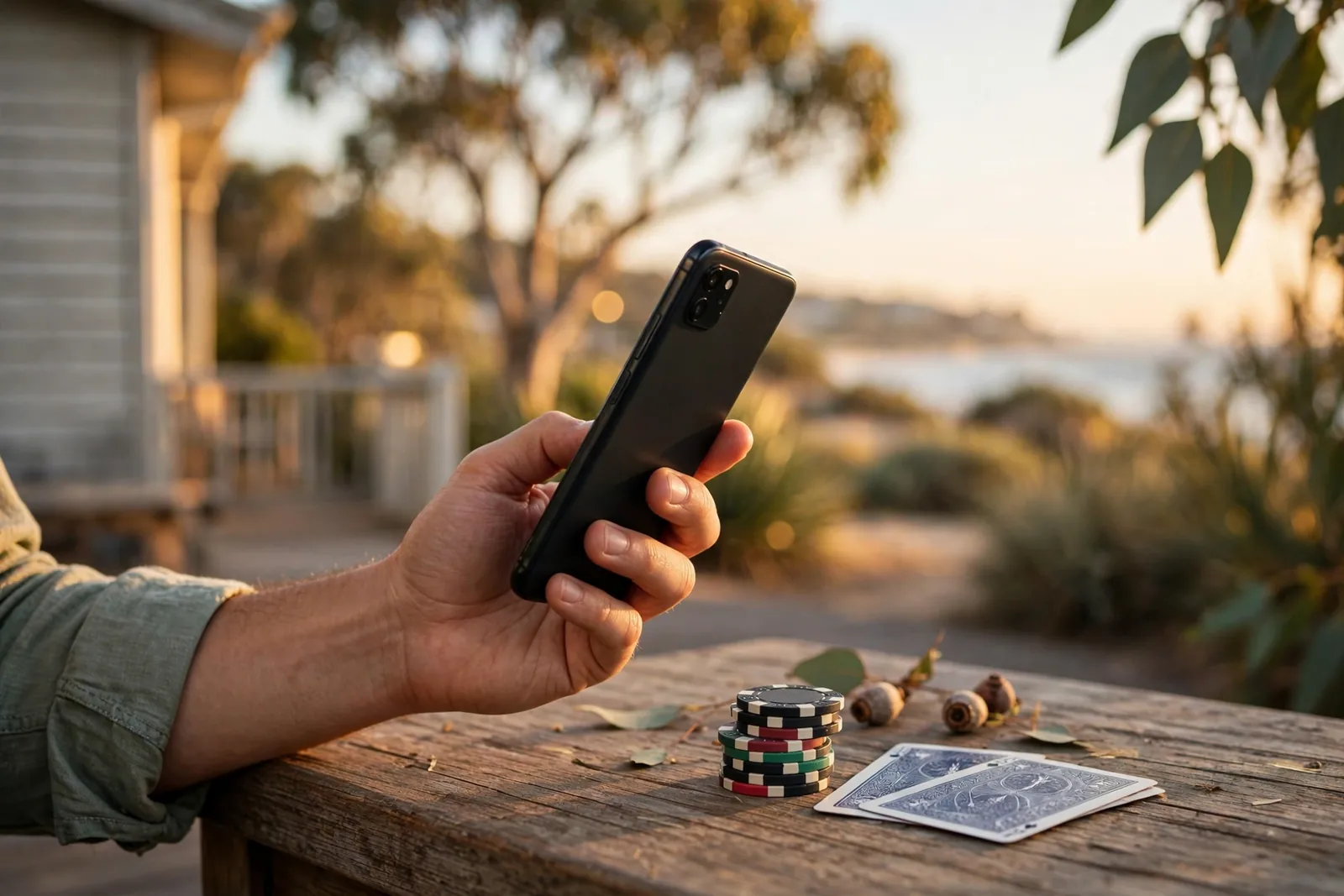
“Real-money” describes the stake and the outcome: money is put at risk, and a win may be paid as money. On a phone, the label can make the service sound like an ordinary app. The legal distinction is not about the screen or the software, though. It is about whether an operator offers online casino-style gambling to someone in Australia.
The Interactive Gambling Act 2001 prohibits operators from offering those games to people located in Australia. That includes casino-style games such as poker, blackjack, roulette and pokies. Putting a casino website in a mobile layout, or calling it an app, does not change the nature of the service. The decisive point is that real-money casino play is being offered to a person in Australia.
That is different from the position of an individual punter. Under the Act, playing at an offshore mobile casino is not illegal for the Australian player. The prohibition applies to the operator offering the service, not to the individual for taking part. Those two statements need to be held together. Saying that a person is not committing an offence by playing does not make the operator’s offer lawful in Australia.
Choosing a casino app in Australia calls for checking the details that matter to you, including licensing and any available payment information. This list provides a concise starting point for reviewing the options.
Neospin
Neospin lists a Curacao Gaming Control Board licence, OGL/2023/176/0095, held by Hollycorn N.V.
Ricky Casino
Ricky Casino lists crypto payouts in under an hour and PayID payouts in 1–3 business days. The minimum deposit is A$20, or A$30 to qualify for the bonus.
Roby Casino
Roby Casino lists a Curacao eGaming licence held by Roby Games Ltd.
Uptown Pokies
Uptown Pokies lists a Curacao licence and has operated since 2017. Its minimum deposit is A$20.
7Bit Casino
7Bit Casino lists a Curacao licence and is operated by Dama N.V.
SpinsUp
SpinsUp lists a Curacao Gaming Control Board licence, OGL/2023/174/0082, held by Dama N.V.
Lucky Dreams
Lucky Dreams lists a Curacao licence. Its minimum deposit is A$20 when using POLi.
LuckyVibe
LuckyVibe lists a Curacao Gaming Control Board licence, OGL/2023/176/0095, held by Hollycorn N.V.
Golden Pokies
Golden Pokies lists a Curacao licence.
Bizzo Casino
Bizzo Casino lists a Curacao Gaming Control Board licence held by TechSolutions Group N.V.
I have seen the distinction blurred by the word “legal”. It is often used as though it answers every question at once. Here it does not. The player’s legal position and the operator’s legal position are separate. A punter may not face liability under the Act for playing offshore, while the service itself remains prohibited from offering real-money casino games to Australian users. Not the same thing.
A casino service accessed on a phone is not necessarily a native app, and the word “app” is not a legal category. The practical differences between those formats are separate from the legal distinction.
The same boundary applies to “casino apps that pay real money” and similar descriptions. The phrase says something about the product being promoted, not whether the product is locally authorised. A payment claim does not establish that an operator may legally offer casino gambling in Australia, and a mobile interface does not turn a prohibited offer into a permitted one. The wording on a promotional page cannot resolve that question.
Age is another basic condition: a person must be at least 18 to register and gamble in Australia. Meeting that requirement does not alter the operator’s position under the Interactive Gambling Act. Nor does the fact that a service accepts a punter’s registration establish that the operator is entitled to provide real-money casino games to someone located in Australia. Access and legal permission are not interchangeable.
This is why “real-money mobile play” needs a narrower meaning than “casino games on a phone”. It refers to a real-money casino service accessed on mobile, commonly offshore, rather than a locally offered online casino service. The legal framework does not permit operators to offer real-money online casino-style games to people in Australia. The individual player, however, is not made criminally liable simply for playing at an offshore casino under this Act.
That difference should remain visible in any discussion of casino apps. Calling an offshore service “available” describes access, not Australian approval. Calling it “real money” describes the stakes, not the legal status. And a claim that a service pays does not settle either point. The terms can sound reassuring while answering a different question.
There is also a practical consequence to treating offshore access as if it were local consumer protection. If an offshore casino refuses to pay winnings, there is no Australian government body to complain to about that refusal. A punter considering such a service should also confirm that the site accepts their location before depositing. Using a VPN to reach a blocked casino may void winnings and lead to account closure. These are risks of dealing with an offshore service, not evidence that the service is locally authorised.
So the clean distinction is this: Australian law prohibits operators from offering real-money online casino games to people in Australia; it does not make an individual Australian player’s offshore play illegal under the Interactive Gambling Act 2001. Age eligibility still applies, and access should not be confused with approval or protection. That is the boundary behind any mobile casino label.
The word “app” often describes the way a casino website is used, not a program downloaded from an app store. In Australia, casino services that accept local users are commonly reached through a mobile browser or a Progressive Web App (PWA). The distinction matters: a browser page loads directly from the site, while a PWA adds a shortcut to the device and presents the same website in an app-like format.
Most mobile casino access starts in the browser. The punter opens the casino’s website, signs in and uses the same account available on desktop. There is no separate mobile account simply because the screen is smaller. That can make switching devices straightforward, but it also means the experience depends on the website and browser working together. A familiar icon on the home screen does not necessarily mean there is a separate native program behind it.
A PWA is essentially a shortcut to a casino website that behaves more like a native app on a mobile device. It can be added from the casino website: the site presents an install or add-to-home-screen prompt, and the user confirms. After that, the shortcut can be opened from the device like an app icon. The underlying service remains web-based.
That is the practical difference. A browser visit requires opening the browser and going to the site; a PWA gives quicker access from the home screen. Neither format guarantees a better connection or a more reliable service. The PWA still depends on the website, the device and its internet connection. An app-like appearance is a convenience, not proof of a different technical or legal status.
I used to treat the icon as the product. It isn’t. The account and service sit on the other side of it.
A common source of confusion is the absence of a familiar app-store listing. Casino apps are rarely listed on Google Play or Apple’s App Store in Australia, so browser access is the default rather than an inferior fallback. This does not mean every site offering a mobile page is trustworthy, or that an app-like shortcut makes a service legitimate. A polished interface answers a design question. It does not settle who operates the service or what recourse exists if a dispute arises.
The word “legitimate” can be doing too much work in descriptions of mobile casino apps. A shortcut can be installed correctly and still lead to an offshore crypto-friendly casino. Before depositing, the site must confirm that it accepts the punter’s location. Using a VPN to reach a blocked casino may void winnings and result in account closure. If an offshore casino refuses to pay, there is no Australian government body to complain to about the unpaid winnings.
There is also a difference between adding a PWA from the casino website and sideloading an app file. The PWA installation described above uses the site’s prompt; it is not the same as downloading an application outside an app store. Sideloaded casino apps carry security risks, and their safety depends on the operator. An app file from an unfamiliar source should not be treated as safer merely because it opens outside the browser.
When mobile play misbehaves, the cause may be less dramatic than the interface suggests. A specialist review identifies poor connection, limited device memory, an outdated browser and too many background apps as common sources of trouble. Those conditions can interrupt loading or make a page unresponsive, whether it is opened directly or through a PWA. The shortcut does not remove those dependencies.
In practical terms, browser access is the baseline; a PWA is a browser-based service made easier to reopen. The difference is useful, but modest. The icon is not the casino.
A welcome bonus can look like extra balance, but the headline is only the entry point. In Australia, real-money online casino games are prohibited for operators to provide to people in the country. Offers attached to offshore play do not turn that service into a locally authorised one. This section explains the mechanics, not a recommendation to claim an offer.
The “free” in a sign-up bonus or no-deposit offer can also mislead. A bonus may not require an initial payment, but its terms can still restrict how it is used and whether any resulting balance can be withdrawn. Where a deposit is required, the minimum deposit is part of the cost calculation: an offer that looks generous may be irrelevant if meeting its entry condition exceeds the amount someone intended to risk.
Wagering requirements set how much qualifying play must take place before bonus funds, or winnings linked to them, become eligible for withdrawal. A specialist review describes welcome-bonus requirements in the 30x to 50x range and treats requirements above 40x as steep. These are descriptions of offers, not a guarantee that a particular operator uses those terms.
The wording matters. A multiplier may apply to the bonus, the deposit, or both, and those bases produce different totals. The advertised figure alone does not settle the calculation. A larger headline bonus can carry a heavier requirement; a smaller offer with less restrictive conditions may be more usable. The arithmetic is the offer.
Game restrictions can further narrow what counts toward wagering. If some games contribute less, or do not qualify, the apparent progress may not match the amount of play required. The terms should say which games count and how. A bonus is not a pile of unrestricted cash.
A specialist review reports that many bonuses carry a clearance window of 7–10 days; if the deadline is missed, the bonus can be lost. The clock may begin when an offer is accepted or credited, so the start point matters as much as the expiry date. A short window can make a high wagering requirement impractical, even when the headline looks substantial.
Minimum deposits, wagering rules and time limits work together. Looking at any one in isolation can distort the value. Before claiming, the complete terms need to be read, including wagering requirements, game restrictions, expiry dates and cashout caps. The cap can limit what is withdrawable even after the wagering condition is met. A “real rewards” label does not remove those conditions.
Any real-money welcome offer relevant to Australian punters comes from an offshore, crypto-friendly casino; it is not a locally provided casino service. Site access can be blocked by the Australian Communications and Media Authority, and a site’s willingness to accept Australian visitors should not be assumed. Its location policy must be confirmed before any deposit. Using a VPN to get around a block may void winnings and lead to account closure. There is no Australian government body to complain to if an offshore casino refuses to pay.
The operational lesson is plain: the headline is designed to attract attention; the terms define the actual offer. If the multiplier, eligible games, expiry or cashout cap is unclear, the advertised value cannot be assessed reliably. No bonus is automatic value.
An iPhone owner may expect a casino service to have a familiar route: open the Apple App Store, find the app, install it and sign in. In Australia, that expectation often does not fit the market. Casino apps are rarely listed in the Apple App Store, and browser access is the default. An absent listing is not, by itself, evidence that a website is broken or that an app has been overlooked.
I have seen the word “app” used loosely in this space. Sometimes it means a native iOS application distributed through Apple; sometimes it means a mobile website saved to the home screen. The distinction matters. A home-screen shortcut can make a website feel app-like, but it is not the same as downloading software from the App Store. The account and service remain web-based.
That is why an iPhone screen can still be the main way to use a mobile casino service without a conventional app installation. The site opens in the browser, and its layout is designed for a smaller display. A punter accustomed to tapping an icon may see the browser address bar and assume the experience is temporary or incomplete. In practice, the distribution method is the point: browser play avoids relying on an App Store listing that may not be available.
Some operators may offer an installation file or instructions outside Apple’s store. “Install directly” sounds like a shortcut; what it really means is that the software has not come through the same store distribution route. Sideloaded casino apps carry security risks, and their safety depends on the operator. An app icon is not proof of independent review, trustworthy handling of data or a safe service. That is a material difference, not a cosmetic one.
Any real-money casino service discussed in this context is offshore and crypto-friendly. The Interactive Gambling Act 2001 bars operators from offering online casino-style games to people in Australia, even though an individual Australian player is not made liable simply for playing offshore. Access can also be disrupted: the Australian Communications and Media Authority blocks illegal gambling sites. Using a VPN to get around a block may breach an operator’s terms, void winnings or lead to account closure. It does not turn the service into a locally authorised one.
Before depositing, the site’s terms must confirm that it accepts the punter’s location. A page loading successfully on an iPhone is not confirmation that the account is eligible to use the service. Nor is a payment option or an attractive offer evidence of local authorisation. The app label does not change the legal position.
There is also a practical limit to what an offshore service’s promises can establish. If an offshore casino refuses to pay winnings, there is no Australian government body to complain to for resolution. That remains true whether the service was opened through Safari, saved as a home-screen shortcut or installed outside the App Store.
“Best casino apps for iPhone” can suggest a tidy set of Apple-approved downloads. That is not a reliable description of Australian access. The more accurate distinction is between a browser-based service, a website shortcut and software installed outside Apple’s store. The last option carries a different security risk; none of the labels settles whether the operator accepts Australian punters or whether a dispute can be remedied locally. Apps are not the same as safeguards.
A free-play casino app can look much like a real-money casino: familiar tables, spinning reels and a balance displayed on screen. The important difference is what that balance represents. Social casino apps use virtual credits for play; they are not a cash balance. A session can be free of deposits and still involve casino-style games, but the credits do not turn the app into a way to win money.
That distinction is easy to blur in promotional language. “Free” describes the play model, not a cash offer waiting to be claimed. Virtual credits let the app run its games without a real-money stake. The experience may imitate casino play, but the balance belongs to the app’s play environment. No cash winnings follow from a high score or a long run of favourable results.
In Australia, social casino apps built around virtual credits can be obtained directly from the Google Play Store or the Apple App Store. That makes them different from offshore real-money casino access, which is not generally presented as a conventional app-store download. The store route is a practical marker of the free-play category, not proof that the app pays cash or offers a route into real-money gambling.
“Safe” and “trusted” need careful handling here. Finding an app in an official store tells what kind of distribution channel it uses; it does not, by itself, establish that every design choice is harmless or that the app is suitable for every user. The useful first check is the way the app describes its balance and purchases. If credits are virtual, the game is free-play in that respect. If an app’s wording suggests cash prizes, the distinction deserves closer inspection rather than being assumed away.
Some free casino apps may use bonus-style language around extra play credits or spins. That language does not make virtual credits equivalent to cash, and it should not be read as a promise of withdrawable winnings. The practical question is whether the app’s rules describe a virtual play balance or a real-money account. Those are different products, even when the screens look similar.
I have seen the interface do most of the persuading: a balance, a button to play again, and celebratory messages after a win. Those cues can make virtual credits feel more substantial than they are. They remain part of the app’s game economy. A punter looking for free entertainment may find that format suits the purpose; someone expecting a cashout is looking at the wrong category.
The short version is plain. Free-play casino apps are available through the major mobile app stores in Australia, and their virtual credits are for play rather than cash winnings. Store availability does not change that basic distinction. A casino-style screen is not a payment account.
On an iPhone or iPad, a deposit screen may sit inside a mobile browser rather than a native casino app. The device does not change how a payment is authorised: the casino account, payment provider and bank still have to agree on the transaction. A polished screen is not evidence that the service is permitted to offer real-money casino play in Australia.
The legal distinction matters before payment details are entered. Under the Interactive Gambling Act 2001, operators cannot provide real-money online casino games to people in Australia. Offshore crypto-friendly casinos may still present payment pages to Australian visitors, but that does not make the service locally authorised. Players must confirm that a site accepts their location before depositing. Using a VPN to reach a blocked casino may breach its terms, void winnings or result in account closure.
Payment options reported for mobile casino accounts include PayID, BPAY, cards and cryptocurrency, with processing dependent on the method and operator. A specialist review describes PayID deposits as near-instant and typically free; that is a report about the service reviewed, not a promise that every transaction will be immediate or cost nothing. POLi should not be treated as a current option: it stopped processing Australian transactions after closing its local operations in September 2023.
A card charge can fail even when the details are correct. Some Australian banks block or flag gambling-related card transactions, so the issuer may decline or hold a payment. A specialist review reports this as a possible cause, rather than a universal rule across banks. Other problems can arise from an incorrect billing detail, a card restriction or a temporary payment-provider issue. Repeated attempts may not solve a bank-side block.
Credit cards should not be used to fund online gambling services. Where a card payment is declined, switching to another route does not resolve the more basic question of whether the offshore service is lawful or suitable. Cryptocurrency introduces its own practical considerations: transfers can be difficult to reverse, and the address and network must match the payment instructions.
Searches for iOS casino apps, iPad casino apps or a “no deposit” offer can blur two different things: the device interface and the underlying real-money service. A home-screen shortcut does not alter payment protections or legal status. Nor does a no-deposit label guarantee cash can be withdrawn; promotional conditions may apply.
I have seen the payment step treated as a technical hurdle, when it is also the point at which account and location checks matter. Keep records of any transaction and avoid sending more funds to resolve a disputed payment. Offshore operators sit outside Australia’s local casino licensing framework, and there is no Australian government body to complain to if one refuses to pay winnings. A failed deposit is frustrating. A larger unresolved balance is worse.
“Pays fast” is not a single processing time. A cashout can pass through the casino’s review queue before the payment provider or bank handles it, so the route and the operator’s pending period both matter. I have seen the headline promise do little to explain that distinction.
E-wallet withdrawals may arrive within 24 hours after the pending period, while bank transfers can take up to five business days.
A specialist review reports that e-wallet withdrawals may arrive within 24 hours after the casino’s pending period. That timing is not a guarantee: the pending stage comes first, and the provider still has to process the transfer. E-wallets such as MiFinity, Skrill and Neteller are used for both deposits and withdrawals, but availability and processing depend on the account’s payment options.
Bank transfers can take up to five business days, according to a specialist review. That is a different clock from the casino’s own approval time. A displayed status such as “processing” may therefore describe only one stage, not the point at which funds reach a bank account.
The first withdrawal can take longer for another reason: identity checks. Casinos commonly require KYC verification before approving an initial cashout. That may mean submitting identification or a selfie, along with proof of address. The check is separate from the payment route; switching methods does not remove it. In practice, a payout can be held until the requested documents have been reviewed.
“Instant” is a claim worth reading narrowly. It may refer to a payment method’s transfer stage, not the full journey from submitting a withdrawal request to receiving funds. I would check the casino’s stated pending period, eligible withdrawal methods and verification requirements before treating a timing claim as meaningful.
There is also a practical limit to what a fast transfer promise can settle. Offshore crypto-friendly casinos operate outside Australia’s locally offered online casino market, and a punter must confirm that a site accepts their location before depositing. Using a VPN to reach a blocked casino may breach its terms, void winnings or lead to account closure. If an offshore casino refuses to pay, there is no Australian government body to complain to for recovery of those winnings.
The payment route matters. So does the approval gate.
An offshore crypto-friendly casino operates beyond Australia’s domestic gambling framework. The Interactive Gambling Act 2001 prohibits operators from providing real-money online casino games to people in Australia, although individual players are not liable under that Act merely for playing at an offshore casino. That distinction does not make the service locally regulated or give its customers Australian consumer protections.
Access is not assured. The Australian Communications and Media Authority actively blocks illegal gambling sites, so a website that opens one day may be inaccessible later. A VPN is not a reliable workaround: using one to reach a blocked casino may breach the operator’s terms, void winnings or result in account closure. Blocking can also leave a punter dealing with a service whose access and support are already uncertain. No simple fix.
Offshore operators may cite jurisdictions such as Curaçao, Malta, or Gibraltar. A licence from one of these places is not an Australian licence, and its existence does not establish that an operator will resolve a dispute fairly. I have seen licence wording do a lot of quiet work in promotional copy: it can sound like local oversight when it is not. Before depositing, the operator must explicitly accept the customer’s location; apparent access to a site is not proof of that.
The practical gap becomes clearest when a withdrawal is disputed. There is no Australian government body to complain to if an offshore casino refuses to pay winnings. A foreign licensing authority may offer a route for complaints, depending on the operator and licence, but that is not the same as Australian recourse. This is the risk behind polished casino gaming apps and mobile sites: the interface can feel familiar while the accountability sits elsewhere.
A specialist review describes controls that may be available, including deposit, loss and wager limits, session time limits, and self-exclusion. Their presence and operation depend on the particular service; a menu item is not the same as an effective safeguard. Sideloaded casino apps bring an additional security risk, and their safety depends on the operator. Browser access avoids installing an app file, but it does not change the legal or oversight position.
The mechanics are plain: access can be blocked, foreign licensing does not create Australian protection, and dispute options may be limited. That is the exposure.
“Popular” sounds like a count of downloads or a chart of native apps. That interpretation is hard to verify in Australia, where casino listings are scarce on both Google Play and Apple’s App Store. For casinos accepting Australians, the working product is more often a mobile website or a Progressive Web App than a standalone app distributed through those stores.
I have seen how the word gets stretched in product copy: a familiar name, a polished mobile page, and a home-screen icon can all be presented as evidence of a “best casino app”. They do not establish how many people use it, whether the software is a native app, or whether its service is suitable for Australians. A shortcut can feel app-like without being a store-listed app. The distinction matters. Presentation is not proof.
That leaves no sound basis for turning popularity into a verified shortlist of named apps. A ranked comparison can still help with practical differences between services, but it should not imply that its order reflects Australian download figures or a reliable popularity measure. Those are separate claims.
In my experience, the most useful check is whether the description matches the product’s real format and states the relevant limitations plainly. A casino that opens in a browser should be described as browser-based, not dressed up as a native app because that wording sounds more familiar.
A label is not a download record. Nor does a home-screen icon make an operator’s service locally approved. The distinction is easy to blur in promotional language; it is not a detail punters should have to infer.
On Android, the word “app” can describe two different things. Social casino apps with virtual credits are available through Google Play and are legal to use in Australia. Offshore real-money casino access is a different route: Australian mobile casinos are generally opened in a browser, with the same account used on desktop.
That distinction matters when comparing what appear to be the best casino apps for Android. A Play Store listing may be for free-play entertainment, not a way to deposit and withdraw cash. An offshore casino may instead offer a mobile website, or an app file downloaded outside the store. The installation method alone does not establish that a service is safe or suitable.
I have seen the sideloading step treated as a minor convenience. It is not. An app installed outside Google Play carries security risks, and its safety depends on the operator. Browser access avoids installing that file, though it does not make an offshore service locally regulated or remove the risks of using it.
Before depositing, the site must explicitly accept the punter’s location. Using a VPN to reach a blocked casino can lead to winnings being voided and the account closed. There is also no Australian government body to complain to if an offshore casino refuses to pay.
A sensible Android comparison starts with the route, not an “app” label: store-distributed virtual-credit play, browser access, or a sideloaded file. Those are not interchangeable products. The icon tells little.
Yes. Real-money casino sites can be accessed through a mobile browser, and a separate app download is not required.
Yes, individual players are not made illegal under the Interactive Gambling Act 2001 simply for playing at an offshore casino. However, operators are prohibited from offering online casino-style games to people in Australia, and offshore access does not mean the service is locally authorised.
They set how much wagering is required before a bonus is cleared. Welcome bonuses commonly require wagering 30 to 50 times the bonus amount; many must be cleared within 7 to 10 days, or the bonus is lost.
Yes. Mobile browser play typically uses the same account as desktop play.
No. Most mobile casino access is through a browser, while a PWA can provide a home-screen shortcut to the website.