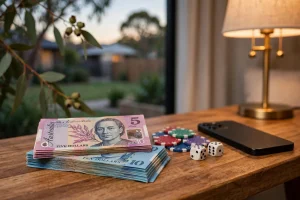
A Bitcoin payment option describes how funds may be accepted, not which game software or machine is available.

A Bitcoin pokie is a digital slot machine that accepts Bitcoin as a form of payment. That definition describes a payment feature, not a particular cabinet, game title or way of playing. The word “Bitcoin” tells us something about how funds may be accepted; it does not establish what the machine looks like or what software it runs.
That distinction matters when a name such as Dragon Link is paired with terms like “machine”, “casino” or “online”. The wording can sound like a precise description, but a label is not proof that a specific physical machine is available, that a digital version exists, or that the two versions share the same design. Those are separate claims. Each needs its own evidence.
In industry language, “pokie” can refer broadly to a slot-style game, while “machine” may suggest a physical cabinet. Online, the same words are often used loosely for a digital game displayed on a screen. The shorthand is convenient, but it blurs the boundary between hardware and software. I have found that this is where copy can quietly make a product sound more established than the information supports.
A physical machine is a piece of equipment in a venue. A digital game is software that can be presented through an online interface. They may belong to the same general category of gambling product, but the shared category does not prove that one is a replica of the other. A name appearing alongside “online” is not enough to establish who made the software, whether it is an authorised release, or whether its rules and presentation match a physical version.
The same caution applies to pictures and descriptions. A photograph of a cabinet, a themed graphic, or wording that resembles a familiar machine name can create an impression of continuity. But appearance alone cannot confirm the underlying product. Nor does the phrase “casino machine” prove that a game is installed at a particular venue or offered by a particular service. Those details depend on the actual product and the context in which it is presented.
Bitcoin, in this description, is a payment method associated with a digital machine. It is not a game feature. The term does not tell us how a game is structured, what symbols it uses, how its interface works, or whether it has any particular bonus round. It also says nothing about the quality or legitimacy of an operator. Those questions cannot be answered by combining a payment label with a game name.
This is a useful editorial distinction, not a technicality. Casino wording often compresses several ideas into one phrase: the title of a game, a type of product, a device, and a payment option. Once those ideas are separated, the claim becomes easier to assess. “Bitcoin pokie” describes a digital slot machine that accepts Bitcoin. It does not, on its own, authenticate a named title or verify a machine version.
For Dragon Link in particular, the name should not be treated as evidence of a specific physical or online product. A reader may use “Dragon Link machine” to mean a cabinet they have seen, a game they have heard about, or an online listing that uses the name. Those meanings are not interchangeable. Without confirmation of the product being described, it would be misleading to write as though they were.
The word “official” deserves the same scrutiny. It is a claim about authorisation, not a decorative adjective. Likewise, “authentic” implies a connection that should be demonstrable. When those terms appear in marketing, the useful question is not whether the wording sounds familiar, but what it actually establishes. A title and a theme are not sufficient proof of origin.
I would also keep the payment description separate from claims about a game’s operation. Accepting Bitcoin does not make a machine more or less genuine, and it does not establish how the game behaves. The payment label answers a narrow question: what form of payment the digital machine is said to accept. It cannot carry the weight of claims about hardware, software, availability or game rules.
This page contains affiliate material and may include sponsored links. That disclosure describes the commercial context of the page; it does not verify any product claim. The distinction remains important. A label can identify a category. It cannot authenticate the machine behind it.
Online pokies can be offered in free-play or real-money mode. The distinction is not a small setting around the same activity: it is how play is funded and whether the credits represent money put at risk. A free-play screen can resemble a cash-play screen, but that resemblance does not make the two modes equivalent.
In free play, the player uses game credits that are not being staked as cash. The session is for trying the game interface or passing time; it does not establish that a real-money version is available in Australia, or that any particular named game offers a free mode. Nor does a simulated balance turn into a cashable win. The credits belong to that play environment.
Real-money play is different because funds are committed to the activity. Results can affect a player’s balance, and the operator’s rules govern how that balance is handled. That change in funding also changes the stakes of the decision. A familiar screen or an identical-looking spin cannot erase the difference.
I have seen promotional language blur this line by presenting “free” as if it were a low-risk route into cash play. It is more precise to treat free play as its own mode. It may show how controls or game presentation work, but it cannot demonstrate what a real-money session will cost, whether an operator will accept a deposit, or how any payout would be treated. A trial is not a promise of access.
For someone searching for a free version of Dragon Link, the sound distinction is between a general free-play option and a claim about that named title. The first is one of the modes that online pokies may offer. The second would require evidence about the particular game and its availability; the mode alone proves neither. The same applies to terms such as “demo” or “practice”: those labels describe an arrangement only when the operator actually provides it.
The Australian setting matters. Under the Interactive Gambling Act 2001, operators cannot lawfully provide real-money online casino-style games, including pokies, to people in Australia. A free-play mode and a cash mode therefore cannot be treated as interchangeable choices for an Australian audience. Describing the general distinction is not an invitation to seek out a cash-play service.
Age is another basic boundary: real-money gambling is for adults aged eighteen or over. Meeting an age requirement does not make an otherwise prohibited service lawful, and a free-play option does not remove the need to understand what mode is being used. Labels can be brief; their practical meaning is not.
There is also a business reason operators separate modes. Free play can introduce a game without asking for a cash stake. Real-money play involves funding and account rules. Those are different commercial arrangements, even where the interface looks alike. In my view, the useful question is not whether a free screen feels authentic, but what the mode permits and what it does not.
A free-play balance should not be read as a financial balance. A result shown in a simulated session does not establish a cash entitlement, and free play cannot be used to infer a likely cash outcome. It can show only the experience within that mode. No more than that.
This distinction also helps make sense of reviews and descriptions. A review that discusses a free mode is not necessarily describing real-money conditions, and a reference to cash play does not confirm that a free version exists for a particular title. The wording should identify which mode it means rather than sliding between them.
This material is affiliate content and may contain sponsored links. That commercial relationship does not change the legal boundary or make one mode a recommendation. “Free” is a funding description, not a guarantee about a game, an operator, or a future cash result. Different modes. Different consequences.
Bitcoin payments have two separate stages: the movement of funds on the blockchain and the operator’s own account processing. A transaction can be sent successfully while a site has not yet credited it; a withdrawal request can be entered correctly while still waiting for the operator to approve and release it. Treating both stages as one instant payment is where expectations often go wrong.
For a deposit, the typical process at a site accepting Bitcoin is to copy the deposit address shown in the account and send Bitcoin to it from a wallet. The address is the destination, not a payment reference that can safely be guessed or reconstructed. A misplaced character can send funds somewhere else. Blockchain transfers are irreversible, so cryptocurrency sent to an incorrect address is generally unrecoverable. That includes Bitcoin and Ethereum. There is no ordinary card-style reversal process.
Address handling matters even when the copied destination appears correct. Deposit non-recognition can result from reusing an address, sending less than the amount the operator expects, or the site detecting the transaction late. These causes sit at different points in the chain: an address issue concerns how the payment is identified, an underpayment concerns the amount received, and detection delay concerns the operator’s accounting. A wallet showing a sent transaction does not, by itself, establish that an account has been credited.
Miner’s fees are part of sending Bitcoin. They vary over time; a specialist review describes them as usually minuscule, but that is a source’s characterisation, not a fixed fee or a promise about a particular transfer. The fee is not the same as the amount sent to the destination. It is also not a substitute for checking the wallet’s final transaction details before confirming. Once broadcast, a transfer cannot be recalled simply because the fee or destination was entered incorrectly.
A withdrawal reverses the direction of travel, but not the basic need for accurate address entry. The account holder requests a Bitcoin withdrawal by copying their wallet address and pasting it into the casino’s withdrawal form. The address should belong to the intended receiving wallet and be checked before submission. If the operator sends funds to the wrong address, blockchain irreversibility makes recovery unlikely. That is a costly typo.
Bitcoin Deposits
Copy the Address
Copy the deposit address shown in the account to ensure accuracy.
Send Funds
Send Bitcoin from your wallet to the copied destination address.
Verify Credit
Wait for the operator to detect the transaction and credit the account.
Withdrawal timing depends on more than the blockchain. A specialist review reports that most Bitcoin withdrawal transactions are completed within an hour. That figure describes the review’s account, not a service guarantee. Before a transaction reaches the network, the operator may still have to approve the request. Common sources of delay include an internal approval queue, unfinished identity checks, or batch processing restricted to business hours. The blockchain cannot speed up a request that has not yet been released by the operator.
This distinction helps explain why a wallet may show no incoming transfer even after a withdrawal request has been submitted. The operator could still be reviewing it, or processing it in a scheduled batch. Conversely, once a transaction has been broadcast, a delay in the receiving wallet’s display is a different issue from an operator approval delay. The useful evidence is therefore not just the account status: it is also whether the operator has actually sent the transaction.
A stuck withdrawal is not a reason to send more money. A demand for an additional deposit to unlock an existing withdrawal should be treated as a serious warning, not as a routine payment step. Keep records of the request, the site’s messages, and any transaction details already supplied. Do not share wallet recovery phrases or private keys; those are not needed to identify a transfer.
These mechanics do not make an offshore gambling service lawful or protected in Australia. Australian law prohibits locally licensed online casinos from offering real-money pokies to residents, and Australian consumer protection laws do not apply to the offshore operators discussed on this page. Real-money gambling is for adults aged 18 or older; that age threshold does not change the legal or consumer-protection position. This is affiliate material and may include sponsored links; that commercial relationship does not establish that a payment process is safe or that a withdrawal will be honoured.
Choosing a site for Dragon Link online pokies in Australia means checking what is actually known about an operator before deciding where to play. This list offers a concise reference to the available details for each option.
Neospin
Neospin is listed with a Curacao Gaming Control Board licence, OGL/2023/176/0095, held by Hollycorn N.V.
Ricky Casino
Ricky Casino lists crypto payouts in under an hour and PayID payouts in 1–3 business days. Its minimum deposit is A$20, or A$30 to qualify for the bonus.
Roby Casino
Roby Casino is listed under a Curacao eGaming licence held by Roby Games Ltd.
Uptown Pokies
Uptown Pokies is listed as operating under a Curacao licence since 2017. Its minimum deposit is A$20.
7Bit Casino
7Bit Casino is listed as operating under a Curacao licence, with Dama N.V. as its operator.
SpinsUp
SpinsUp is listed with a Curacao Gaming Control Board licence, OGL/2023/174/0082, held by Dama N.V.
Lucky Dreams
Lucky Dreams has a stated minimum deposit of A$20 via POLi and is listed with a Curacao licence.
LuckyVibe
LuckyVibe is listed with a Curacao Gaming Control Board licence, OGL/2023/176/0095, held by Hollycorn N.V.
Golden Pokies
Golden Pokies is listed with a Curacao licence; no further operator details were provided.
Bizzo Casino
Bizzo Casino is listed with a Curacao Gaming Control Board licence held by TechSolutions Group N.V.
The name Dragon Link may appear in discussions of online pokies and Australian players, but that does not make it a product offered under Australia’s local online-casino licensing system. The distinction is important: a title’s presence on an offshore site does not change the legal position of the operator or turn the service into a locally licensed one.
The Interactive Gambling Act 2001 prohibits operators from providing real-money online casino games, including pokies, to people physically located in Australia. The restriction concerns the service being offered to customers here. It is not a question of whether a game’s name sounds familiar, whether a website accepts Australian registrations, or whether its pages use Australian terminology. A site’s willingness to take a customer does not establish local authorisation.
That sets a firm boundary around what can responsibly be said about Dragon Link in this market. The title can be discussed as a name appearing in offshore online-pokies material, but that is different from saying it is available through a lawful Australian online casino. I would not treat a search result, a promotional page or a downloadable interface as proof of a locally approved real-money game. Presentation is not permission.
The operators discussed in this context hold offshore licences, primarily from Curacao eGaming or the Anjouan Gaming Authority. Those licences are issued outside Australia. They do not amount to Australian online-casino licences, and they do not displace the prohibition on operators providing real-money pokies to people in Australia. “Licensed” can sound like a complete assurance; here, the useful question is where the licence comes from and what it does not establish.
There is a further practical distinction. Australian consumer protection laws do not apply to the offshore operators discussed. That matters because a foreign licence and an Australian consumer remedy are not interchangeable. An offshore operator’s stated terms remain the operator’s terms; the existence of a licensing label abroad does not bring the service within Australia’s consumer-protection framework. A familiar game name does not bridge that gap either.
I have seen how quickly product wording can blur these categories. A page may use “Australian” to describe its intended audience, its currency display or its search terms, while the operator itself remains offshore. That wording describes presentation, not the legal status of the service. Likewise, calling something an online Dragon Link pokie does not establish that the game is supplied by a locally authorised casino. Labels travel easily. Regulatory status does not.
This section is informational, not an invitation to access or use an offshore casino. The content is affiliate material and may include sponsored links; that disclosure does not make a prohibited service lawful or amount to an endorsement. The boundary remains straightforward: Australian law prohibits operators from offering real-money online pokies to residents, and the offshore operators discussed are not covered by Australian consumer protection laws.
For the named game, the Australian context is therefore chiefly a limit on what the label can imply. It does not establish local availability, Australian licensing or consumer-protection coverage. A name on a screen is not a domestic licence.
A licence badge is a claim about the operator, not proof that every service it offers is lawful or that a particular game is available to Australians. Operators discussed in this market hold offshore licences, primarily from Curacao eGaming or the Anjouan Gaming Authority. The Interactive Gambling Act 2001 prohibits operators from providing real-money online casino games to people in Australia. An offshore licence does not remove that restriction, and Australian consumer protection laws do not apply to offshore operators.
I have seen “properly licensed” used as if it settled the whole question. It does not. The issuing authority, the entity named on the licence and the service actually being offered all matter. A badge or a review’s reassuring label is not a substitute for checking what the licence covers. Nor does a review describing a casino as having a broad pokies selection establish that a named game, such as Dragon Link, is available there.
Reviews need the same separation between description and evidence. A specialist review may recommend considering licensing, user feedback and game selection, but those are criteria to examine, not guarantees about payments or access. Commercial relationships can also shape what a review emphasises. This content is affiliate material and may include sponsored links.
Verification is another point where the sales language and the operating process diverge. Registration checks may be followed by identity and address checks, with stage two triggered at a first withdrawal or once cumulative deposits reach AUD 2,000–5,000, depending on the operator. That means an account used for some time can still face a document request when funds are being withdrawn. The threshold is not uniform.
Crypto-specific checks can add a separate ownership question. A specialist review describes possible requests to sign a message using the deposit address or provide a wallet screenshot showing the sending transaction. These are reported procedures, not a universal standard. An operator may want to connect the payment source to the account holder; until that review is accepted, access to funds can be delayed.
In my experience, the timing of a check matters as much as its stated purpose. A request made at withdrawal can feel like a changed condition, even where the operator treats it as part of account review. Keep the licence claim, review language and verification rules distinct. None of them confirms that real-money online casino play is legally offered in Australia. Adults aged eighteen or over are the minimum audience for real-money gambling, but age does not change the legal position.
Bitcoin’s advertised advantages concern the payment network, not the game attached to it. A claim that a transaction is secure says nothing about whether a game is fair, whether a jackpot will be won, or whether an operator will approve a withdrawal. Those are separate matters.
Blockchain records make Bitcoin transactions difficult to alter once confirmed. That is a meaningful security property, but it is not protection against every failure. A transaction sent to the wrong address is generally unrecoverable because it cannot simply be reversed like a card payment. Security at the network level does not correct a copying mistake or guarantee that a casino will handle a payment properly. Different layers. Different risks.
“Anonymous” is another word that needs narrowing. A specialist review describes Bitcoin as offering a degree of anonymity compared with traditional payment methods. That is a relative claim, not a promise of invisibility. A public blockchain records transactions, and an exchange or casino may separately hold account and identity information. The payment method can disclose less to some parties than a conventional payment route while still leaving a traceable transaction history.
Fees also depend on what is being compared. A specialist review characterises Bitcoin transaction charges as lower than those associated with credit cards and other conventional methods. That comparison should not be read as a fixed price or a guarantee that every transfer costs less. Bitcoin transactions incur miner’s fees, and those vary over time. The amount charged by a casino or payment service, if any, is a separate question from the network fee.
None of these characteristics provides evidence about Dragon Link, a related online game, or any jackpot label. A payment method cannot establish a game’s rules, payout structure, or odds. Nor does using Bitcoin make a prize more likely. Payment claims and game claims belong in different columns.
I have seen “fast” and “private” used as if they settled the whole decision. They do not. The practical meaning is narrower: blockchain transactions have particular security properties, Bitcoin may offer comparative privacy, and fee comparisons depend on the route and conditions. The operator still controls its own account procedures, and an irreversible transfer leaves little room to undo an error.
This page is affiliate material and may include sponsored links. That commercial relationship does not turn a payment feature into a game guarantee.
Advice about a slot can describe how a game works, but it cannot establish that a particular spin will win. Claims about Dragon Link winners or reliable ways to produce a payout should be treated as claims, not as evidence of a repeatable method. I have seen “tips” used to make uncertain outcomes sound manageable. They are not a guarantee.
Bonus terms create a separate set of conditions. A wagering contribution percentage determines how much play on a particular game counts toward a bonus requirement. The percentage may differ between game types: table games can contribute 0%, while pokies can contribute 100%. Some high-RTP slots may be capped at 50%. Those figures describe possible terms, not a universal schedule; the operator’s rules determine what applies.
That distinction matters when a bonus is attached to play. A game that appears eligible may contribute less than expected, or not count at all under the stated rules. If the contribution table is unclear, disputes can follow over whether enough qualifying play took place. The wording is consequential. “Eligible” does not necessarily mean that every wager counts in full.
Maximum-bet conditions are another point where bonus play can go wrong. Exceeding the limit set in the terms may void bonus play. A win does not, by itself, settle whether the conditions were followed; the operator may assess the play against the bonus rules. The relevant limit is the one written into those terms, not an assumption carried over from another promotion.
I would read the contribution schedule and maximum-bet clause together before treating a bonus as usable. “Free” can describe the promotion’s headline, while the restrictions decide how play is counted and whether winnings remain eligible. Fine print matters.
This material is affiliate content and may include sponsored links; that does not change how bonus conditions work. Any real-money gambling discussed is for adults aged 18 or older.
The phrase “Dragon Link app” can suggest a dedicated mobile application, but the name alone does not establish that one exists. Nor does it show that a particular app contains a Dragon Link game, supports a specific account, or offers functions tied to that title. Those are separate claims, and each needs evidence of its own.
I have seen how a familiar game name can be carried across listings and promotional pages until repetition starts to look like confirmation. It is not. A page that opens on a phone may be a mobile website; an icon saved to a phone’s home screen may simply open that website. Neither detail proves that the game has a native app or app-specific features.
The same care applies to claims about an app’s return-to-player figure. An RTP is a game statistic, not a property established by an app label. Without reliable details identifying the exact game and the basis for the figure, attaching an RTP to a supposed Dragon Link app would turn an unconfirmed association into a precise-sounding claim.
I would separate three things: a mobile-friendly page, an application offered by an operator, and a verified Dragon Link title within that application. Evidence for one does not establish the others. A logo, screenshot or brief listing may identify what is being advertised, but it does not by itself confirm the software’s origin or functions.
That distinction matters in Australia, where real-money online casino games are prohibited for operators to provide to people physically in the country. An app label does not change that legal position, and should not be read as assurance that a service is authorised or available locally.
So the careful description is limited: a Dragon Link-branded app and app-specific functions cannot be treated as established simply because the wording appears in a listing. No confirmed feature set. No assumed RTP.
The general Bitcoin setup begins outside any game. Bitcoin can be bought through a cryptocurrency exchange using conventional currency. Opening an exchange account involves supplying basic information and creating a secure password; the exact checks and steps depend on the exchange. That process creates access to a digital asset, not evidence that a particular gambling service is lawful or available in Australia.
I have seen payment setup presented as if it were the beginning of a straightforward route to play. It is not. Australian law prohibits operators from providing real-money online casino games, including pokies, to people physically in Australia. Offshore services are not a locally licensed alternative, and Australian consumer protection laws do not apply to the offshore operators discussed here. A payment method does not change those conditions.
Nor does having Bitcoin explain how Dragon Link works. The name alone does not establish the rules, controls or outcomes of any particular game. There is no setup step that can guarantee a win; purchasing cryptocurrency or creating an account cannot answer how to play a game whose specific mechanics have not been established.
I keep those questions separate. Acquiring Bitcoin is a financial action. Establishing a game’s rules is a different matter, and neither action makes a prohibited service lawful. Real-money gambling is restricted to adults aged eighteen or over. This page is affiliate material and may include sponsored links; that disclosure is not an endorsement or an invitation to use an offshore casino. A payment route is not permission.
“Happy and Prosperous” reads like a descriptive title, but the words do not explain how a game operates. In the Dragon Link context, treating that phrase as a distinct, established version would go further than the name itself allows. A title can identify what someone is looking for; it cannot, by itself, establish a game’s rules or terms.
I have seen product names do a lot of quiet work. “Prosperous” can suggest good fortune, while “happy” gives the label a positive tone. Neither word is a statement about what a player will experience. They are not evidence of a particular feature, a payment arrangement or a likely result. That distinction matters whenever promotional language is mistaken for a description.
The same applies to variations in punctuation. “Happy and Prosperous” and “Happy & Prosperous” may be written differently, but the ampersand does not establish a separate release or a different set of rules. A name alone cannot settle that question.
For anyone encountering the phrase beside Dragon Link, the sound approach is to keep the claim narrow: it is a title being used in connection with the name. Any further description should be supported by clear information attached to the actual game or its operator, rather than inferred from the wording. I would not turn an upbeat title into a claim about play or outcomes.
That is the practical boundary. Recognise the name, but do not read a promise into it. A polished label remains a label.
Yes, Bitcoin can be used to fund play at offshore casinos, and online pokies may also offer free play. Australian-licensed online casinos cannot offer residents real-money pokies, and Australian consumer protection laws do not apply to the offshore operators discussed.
Yes, verification may be requested, including at a first withdrawal or after cumulative deposits reach an operator’s threshold. Crypto checks may involve signing a message from the deposit address or showing the wallet transaction.
Free-play credits are not Bitcoin and cannot be cashed out as Bitcoin. To obtain Bitcoin, you can buy it with fiat currency through a cryptocurrency exchange.